H.R. PLASTIC MACHINERY PVT. LTD.
Waste Plastic Recycling Plant Manufacturer
Waste Plastic Recycling Plant Manufacturer
Waste Plastic Recycling Plant Manufacturer in India | Turnkey Washing, Extrusion & Pelletizing Lines
```
```
Waste Plastic Recycling Plant Manufacturer
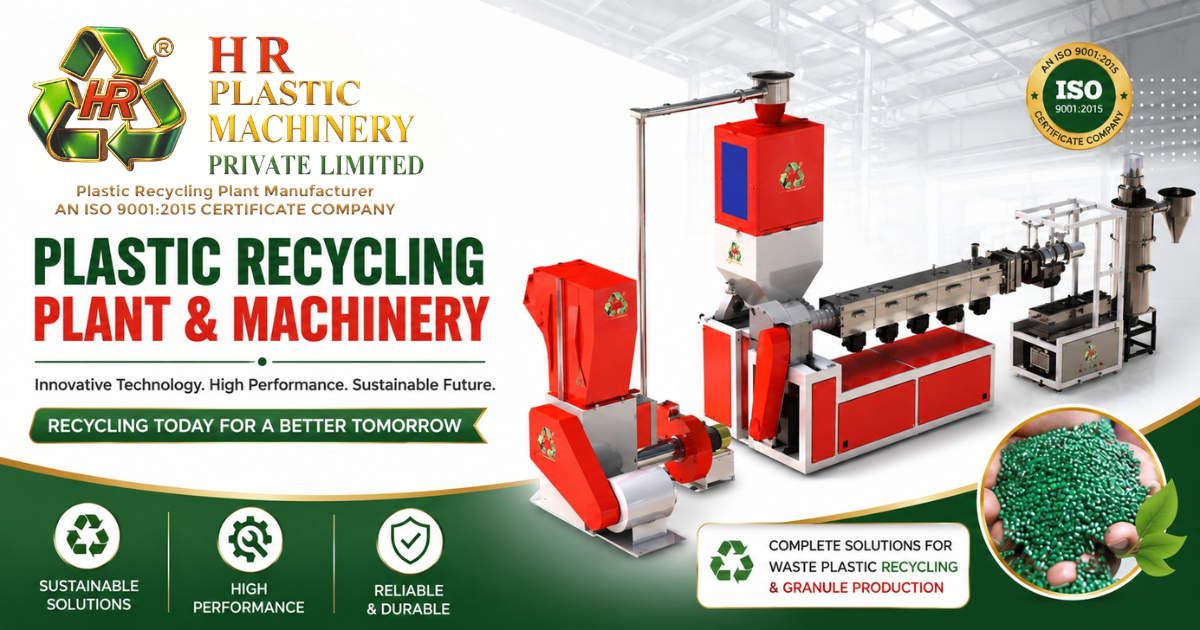
As a specialist waste plastic recycling plant manufacturer, we engineer robust washing, extrusion, and pelletizing lines that convert mixed post-consumer and post-industrial scrap into consistent, saleable granules. Our modular systems cover size reduction, hot and cold washing, drying, melt filtration, vacuum degassing, and pellet cutting. Each project is tailored for feedstock type, contamination level, and target MFI. We focus on energy efficiency, water recovery, operator safety, and lifecycle support so Indian processors achieve reliable output quality and predictable operating costs.
Working Principle and Process Flow of Waste Plastic Recycling Plants
Typical flow starts with inspection and sorting, followed by shredding or crushing, label and metal removal, friction and hot-wash cleaning, float-sink separation, rinsing, and centrifugal drying. Clean flakes feed a forced-feed or vented extruder with multi-zone heating, automatic screen changing, and high-vacuum degassing to remove inks and volatiles. The melt passes through die-face or strand pelletizers and is cooled, dried, and classified. SCADA records kWh/kg, throughput, alarms, and recipe data for traceability. Explore layouts and options on hrplasticindia.com.
Types of Waste Plastic Recycling Plants We Build
- PE film recycling lines for LDPE/LLDPE carry bags and stretch film with agglomerator, forced-feed extruder, and die-face pelletizer.
- Rigid HDPE/PP drum and crate lines with label remover, sink-float separation, intensive washer, and vented extrusion.
- PET bottle washing and pelletizing with hot caustic modules, IV control, and stainless steel wetted parts for food-contact compliance goals.
- Two-stage recycling plants for highly printed, damp, or mixed feedstock to stabilise melt and reduce odour.
- Decentralised compact plants (150–300 kg/hr) for material recovery facilities and cluster recyclers in tier-II/III cities.
Key Features and Specifications
- Energy-efficient motors with VFDs and documented kWh/kg benchmarks for OPEX planning and audits.
- Automatic screen changers, multi-stage filtration (50–120 mesh), and high-vacuum venting for clean, stable melt.
- Food-grade PET modules with SS304/SS316 contact parts, controlled hot-wash chemistry, and IV retention.
- PLC-SCADA with recipe control, preventive maintenance prompts, alarm logs, and remote diagnostics.
- Water recycling skids, deodorising systems, and bolt-on capacity upgrades with standardised spares.
Applications of Recycled Plastics
- Packaging films, liners, and sacks using rLDPE/rLLDPE with defined MFI, gel count, and printability targets.
- Injection-moulded crates, pails, and caps from rPP and rHDPE meeting impact and dimensional stability needs.
- Textile fibre, strapping, and sheet from rPET with tensile and elongation controls for apparel and industrial uses.
- Automotive and appliance non-critical components from rPP, HIPS, and ABS aligned with corporate sustainability goals.
Benefits of Choosing a Trusted Manufacturer
- Lower lifecycle cost through optimised energy and water usage, high uptime, and quick availability of standard spares.
- Consistent pellet quality via controlled washing, multi-stage filtration, and vacuum degassing that reduce rejections.
- Higher productivity with automated dosing, recipe control, and fast screen changes that cut changeover time.
- Compliance and audit readiness with safety guarding, traceability data, and EPR-aligned documentation.
Manufacturing & Supply Capabilities
We deliver turnkey lines including layout engineering, utility planning, installation, commissioning, and operator training. Standard scopes cover shredders, washers, dryers, conveyors, extruders, screen changers, pelletizers, and control panels. Options include stainless contact parts, centralised SCADA, effluent and water recycling, odour capture, and gravimetric dosing. Service coverage spans major industrial hubs with defined response times and performance guarantees tied to throughput and contamination limits.
Maintenance and Safety Tips
- Track bearing temperature, vibration, and knife wear; replace screens and seals as per schedule.
- Maintain wash chemistry and TDS; clean tanks, spray bars, and filters to avoid re-contamination.
- Calibrate load cells, pressure sensors, and temperature loops; validate target MFI regularly.
- Train operators in lockout-tagout, hot surfaces, and confined-space practices; test emergency stops.
- Stock critical spares—heaters, thermocouples, gear seals, breaker plates, and screen packs.
FAQs – Waste Plastic Recycling Plant Manufacturer
1. Which plant configuration is ideal for mixed LDPE film with high moisture?
+
A film line with agglomerator, forced-feed vented extruder, high-vacuum degassing, and die-face cutting stabilises output. Include intensive friction wash and efficient drying to control moisture before extrusion.
2. Can one plant process both rigid HDPE and PP efficiently?
+
Yes, with separate recipes, screen packs, and sometimes a quick-change cutter and dosing system. Dedicated washing paths improve quality when switching between materials.
3. What utilities are required for a 500–800 kg/hr line?
+
Three-phase power, process water with recycling loop, and compressed air. Plan for ETP, chiller or cooling tower, and backup power to ensure steady production during grid variations.
4. How do we ensure colour consistency and low odour in pellets?
+
Use hot-wash chemistry control, density separation, multi-stage filtration, and high-vacuum vents. Keep feedstock streams segregated and monitor residence time and melt temperature.
5. What after-sales support should be expected?
+
Installation and commissioning, operator training, preventive maintenance schedules, remote diagnostics, and guaranteed spares with defined response times and performance benchmarks.
Contact Details
Talk to our specialists today for tailored solutions and fast assistance.
Company: Hr Plastic India
Phone: +91 95102-05025
WhatsApp: Chat on WhatsApp
Email: [email protected]
Website: www.hrplasticindia.com
Address: Office Address :- 3, Abhishree Industrial Park, B/h. G.V.M.M., Near Odhav Circle, Ahmedabad-382415.
Recent Posts