H.R. PLASTIC MACHINERY PVT. LTD.
PVC Mixture Machine in Gujarat
PVC Mixture Machine in Gujarat
PVC Mixture Machine in Gujarat | HR Plastic Industries
PVC Mixture Machine
Industrial Machinery — Gujarat
PVC Mixture Machine
in Gujarat
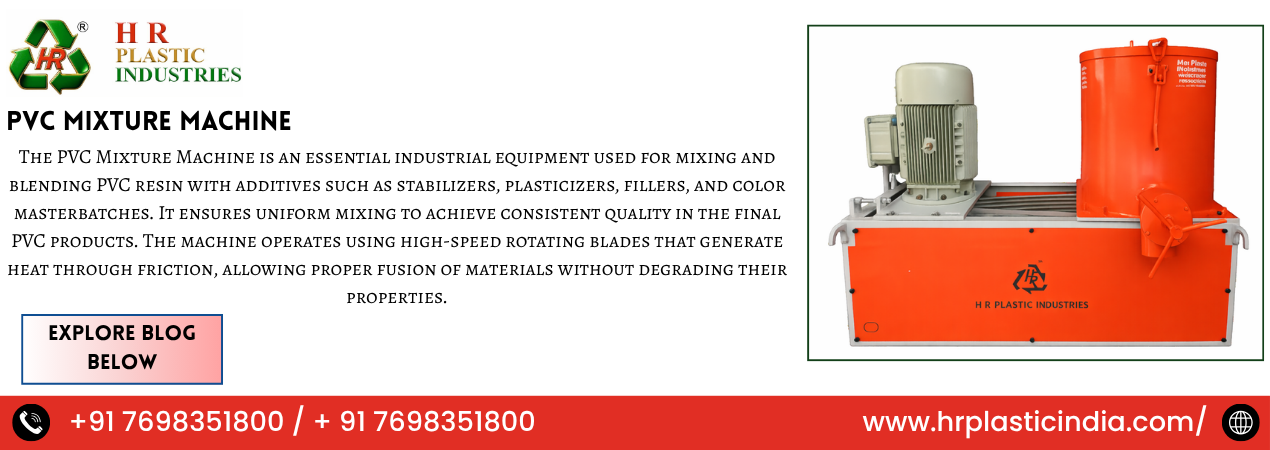
PVC processing requires consistency, controlled formulation, and precise material preparation before extrusion or molding begins. A PVC Mixture Machine in Gujarat plays an important role in this process by supporting uniform blending of PVC resin with additives such as stabilizers, fillers, lubricants, pigments, and plasticizers.
Ahmedabad · Vadodara · Rajkot · Surat · Gujarat
Overview
PVC Mixture Machine in Gujarat
In industrial manufacturing, the quality of the final PVC product often depends significantly on the efficiency of the mixing stage during compound preparation.
Across Gujarat's expanding plastic processing sector, manufacturers involved in pipes, profiles, cables, sheets, fittings, and recycled compounds increasingly rely on efficient mixing systems to maintain productivity and material uniformity. High-speed PVC mixture machines are designed to support these requirements through controlled heating, rapid blending, and integrated cooling processes that prepare compounds for downstream production.
With growth across industrial centers such as Ahmedabad, Vadodara, Rajkot, Surat, and other manufacturing regions, demand for dependable PVC mixing technology continues to rise among both large-scale and medium-scale operations.
Working Principles
Understanding PVC Mixture Machine Working Principles
A PVC mixture machine is generally designed as a high-speed mixing system where raw materials are blended through controlled mechanical action. Rotating blades generate frictional heat, allowing the resin and additives to fuse uniformly without affecting material properties.
The process usually involves two coordinated stages. In the hot mixing stage, ingredients are intensively blended at elevated temperatures to achieve proper dispersion. This is followed by a cooling stage, where material temperature is reduced to stabilize the compound before further processing.
This controlled mixing sequence helps improve:
- Uniform additive distribution
- Compound consistency
- Flow characteristics during extrusion
- Reduction in material degradation
- Batch-to-batch quality repeatability
Modern machines may also include automated feeding systems, PLC controls, temperature monitoring, and programmable mixing cycles that enhance process control while reducing manual dependency.
Importance
Why PVC Mixing Quality Matters in Manufacturing
In PVC production, poor mixing can lead to inconsistent formulations, processing challenges, product defects, or reduced mechanical performance. Uniform blending influences critical factors in finished products, including strength, surface finish, dimensional consistency, and processing stability.
A properly designed PVC mixture machine helps manufacturers manage formulation precision while improving output efficiency. This is especially valuable in sectors where product consistency and repeatable processing are essential.
Industries producing rigid PVC compounds, flexible PVC formulations, recycled compounds, and specialty blends often depend on high-performance mixing systems to maintain production standards while supporting material efficiency.
Features
Key Features of PVC Mixture Machines
Modern PVC mixture systems are designed for industrial-duty performance while supporting efficiency and operational control. Common functional features often include:
- High-speed mixing blades for rapid and uniform blending
- Friction-based heating process for compound fusion
- Durable mixing chamber construction for long-term operation
- Automatic temperature and time controls
- Efficient discharge arrangements for smoother workflow
- Integrated cooling systems for compound stabilization
- User-friendly control panels for process monitoring
- Energy-efficient motor configurations for continuous use
These features support improved productivity while helping operators maintain control over critical formulation parameters.
Applications
Applications of PVC Mixture Machine in Gujarat
PVC mixing systems support a wide range of industrial applications due to their versatility in handling different formulations and processing requirements.
Common application sectors include:
- PVC pipe manufacturing
- Cable insulation compound production
- PVC sheet and profile manufacturing
- Masterbatch and color compound preparation
- Plastic recycling and reprocessing units
- Chemical and polymer compounding industries
- Construction material production
- Packaging material processing
As Gujarat remains a major hub for plastic and polymer manufacturing, these applications continue driving demand for reliable mixing solutions.
Process
Role of Hot and Cooling Mixers in Compound Stability
One of the major advantages of advanced PVC mixing systems is the integration of hot and cooling stages. This dual-stage approach improves compound handling while supporting material stability.
During hot mixing, ingredients are blended under controlled temperature rise, allowing additives to disperse effectively. The cooling phase then reduces material temperature rapidly, helping avoid over-processing while preserving formulation properties.
This process often contributes to improved:
- Processing stability during extrusion
- Surface quality of final products
- Reduced moisture-related issues
- Lower chances of agglomeration
- Better storage and handling characteristics
For manufacturers working with demanding formulations, this approach can significantly improve downstream production performance.
Selection Guide
Factors to Consider When Selecting a PVC Mixture Machine
Choosing the right PVC mixture machine depends on production objectives, formulation requirements, and plant capacity. Machine selection is often based on more than mixing speed alone.
Important factors to evaluate include:
- Batch capacity requirements
- Material compatibility
- Heating and cooling efficiency
- Motor power and energy usage
- Automation and control features
- Maintenance accessibility
- Discharge efficiency
- Long-term operational durability
Matching machine configuration with production requirements helps improve efficiency while supporting reliable compound preparation.
Market Demand
Industrial Demand for PVC Mixture Machines in Gujarat
Gujarat has developed into one of India's major centers for plastics, petrochemicals, and polymer-based manufacturing. This industrial ecosystem has contributed significantly to demand for processing machinery, including PVC mixture systems.
Growth in infrastructure, packaging, electrical products, irrigation systems, and recycled plastic processing has increased the need for efficient compounding equipment. Manufacturers often seek systems capable of handling varied formulations while maintaining productivity and process control.
As production expectations continue rising, modern mixing machines are increasingly valued not only for blending performance but also for operational consistency and material efficiency.
Benefits
Operational Benefits of PVC Mixture Machines
Beyond mixing performance, these systems offer several process-related advantages that support industrial productivity.
Operational benefits often include:
- Reduced manual material handling
- Lower chances of formulation inconsistency
- Faster batch preparation cycles
- Improved production throughput
- Better material utilization
- Lower degradation risks during mixing
- Support for consistent product quality
These factors contribute to improved process efficiency across compounding and extrusion operations.
Maintenance
Maintenance Considerations for Long-Term Performance
Like other industrial processing equipment, routine maintenance plays an important role in sustaining performance. Proper upkeep helps preserve mixing quality, reduce downtime, and extend service life.
Maintenance practices often involve monitoring blade wear, inspecting chamber surfaces, checking cooling systems, verifying control settings, and maintaining motor and drive components.
Consistent preventive maintenance can support:
- Stable mixing performance
- Reduced unexpected breakdowns
- Longer equipment life
- Improved process reliability
- Lower operating disruptions
For continuous production environments, maintenance planning remains a practical part of long-term machine performance management.
Future Trends
Future Trends in PVC Mixing Technology
PVC processing machinery continues evolving with greater emphasis on automation, energy efficiency, and process control. Advanced systems increasingly incorporate intelligent controls, recipe programming, automated feeding, and enhanced monitoring systems.
Manufacturers are also focusing on systems designed for handling recycled materials and specialized formulations, reflecting broader shifts in material processing requirements.
As smart manufacturing adoption grows, mixing technology is expected to move toward higher precision, improved efficiency, and reduced operational variability.
A PVC Mixture Machine in Gujarat serves as a vital part of compound preparation across diverse plastic processing industries. From blending PVC resin and additives to supporting compound stability and production efficiency, these systems contribute significantly to consistent manufacturing outcomes.
With expanding demand across pipes, profiles, cable compounds, recycling units, and polymer processing sectors, reliable mixing technology continues to play an important role in industrial operations. Selecting the right system based on formulation needs, capacity, and process requirements can support both product quality and long-term production efficiency.
FAQ
Frequently Asked Questions
What is a PVC Mixture Machine used for?
A PVC mixture machine is used to blend PVC resin with additives such as stabilizers, fillers, pigments, and plasticizers to prepare uniform compounds for further processing applications.
How does a PVC Mixture Machine work?
It operates through high-speed rotating blades that generate frictional heat for mixing, followed by a cooling stage that stabilizes the prepared compound before extrusion or molding.
Which industries use PVC Mixture Machines?
These machines are commonly used in PVC pipe manufacturing, cable production, profile extrusion, plastic recycling, masterbatch production, and chemical processing industries.
Why is hot and cooling mixing important in PVC processing?
The hot and cooling process supports uniform additive dispersion, helps prevent over-processing, improves compound stability, and enhances downstream production performance.
What should be considered when selecting a PVC mixer?
Factors such as batch capacity, automation level, mixing efficiency, cooling performance, material compatibility, and maintenance requirements are commonly evaluated.
Are PVC Mixture Machines suitable for recycling applications?
Yes, many systems are used in recycling and reprocessing operations for preparing recycled PVC compounds and supporting material consistency.
Recent Posts