H.R. PLASTIC MACHINERY PVT. LTD.
Automatic Plastic Recycling Line Supplier
Automatic Plastic Recycling Line Supplier
Automatic Plastic Recycling Line Supplier
Introduction to Automatic Plastic Recycling Line Supplier
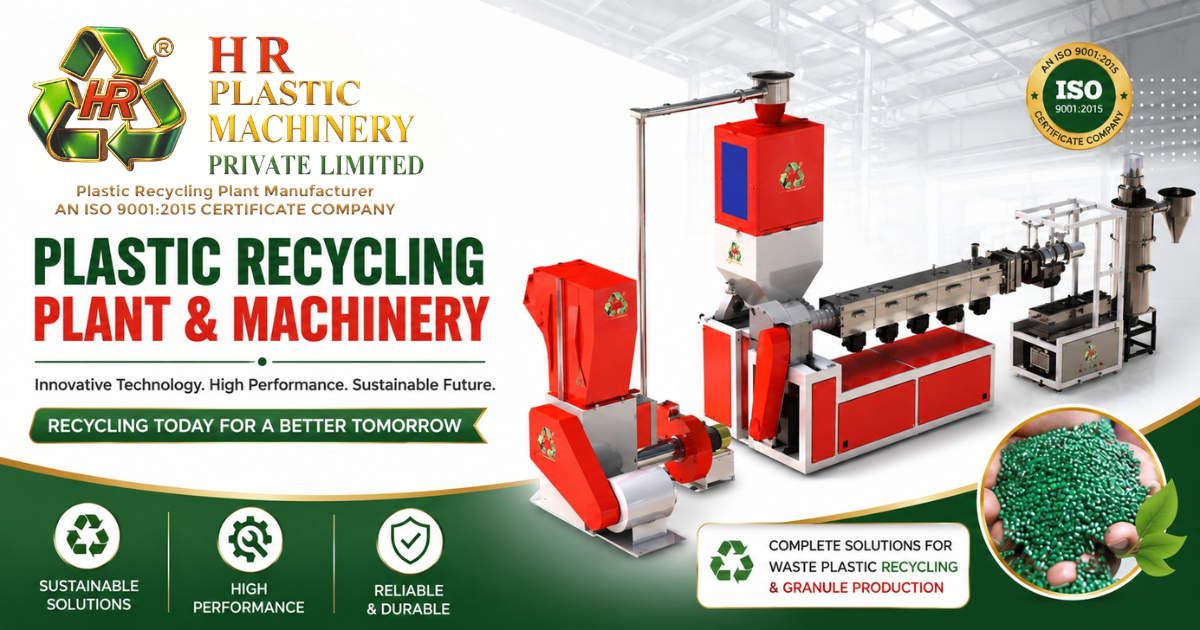
An Automatic Plastic Recycling Line Supplier provides turnkey systems that transform mixed or single-polymer scrap into high-quality granules ready for reuse. Typical lines integrate crushing, washing, drying, extrusion, filtration, and pelletizing to deliver consistent output and reduced waste. Reliable Indian suppliers help processors cut raw-material costs, stabilize quality, and meet sustainability goals. With modular configurations, plants can be tailored for films, rigid packaging, woven sacks, or injection moulding waste. For specifications, maintenance know-how, and project guidance, explore the manufacturer’s plastic recycling resources. Service support covers installation, training, and spare parts.
Working Principle and Process Flow of Automatic Plastic Recycling Line Supplier
An automatic plastic recycling line starts with conveyor-fed shredding to reduce scrap size. A friction washer loosens contaminants, followed by float-sink tanks separating polyolefins from heavier materials. High-speed dewatering and thermal dryers remove moisture before feeding a vented extruder. Melt filtration screens out fines and paper residues, while backflush or continuous filters sustain pressure. A strand or die-face hot cutter pelletizes the melt into uniform granules, then an air conveyor cools and conveys pellets to storage silos. Integrated PLC/SCADA controls balance temperatures, screw speed, and throughput for steady quality. For typical layouts and options, see the process overview.
Types of Automatic Plastic Recycling Line Supplier
- Single-stage vented extrusion line for clean post-industrial scrap; ideal for film converters and injection moulders targeting quick changeovers.
- Two-stage agglomeration plus extrusion line for printed, washed films; boosts degassing and stabilizes melt for consistent pellets.
- High-capacity twin-screw system for blended formulations; handles fillers, additives, and color masterbatches with excellent dispersion.
- Compact modular line with integrated crusher-washer-dryer; suitable for SMEs needing low footprint and simplified installation.
- Heavy-duty recycling line for woven sacks and rigid packaging; reinforced wear parts ensure durability under abrasive loads.
Key Features and Specifications of Automatic Plastic Recycling Line Supplier
- Throughput options from 150 to 1200 kg/h, documented at ±3% output stability under typical feed variability.
- Energy-optimized motors with VFDs and barrel heating zones reduce kWh per kilogram by measurable margins.
- Dual-piston continuous screen changers maintain melt pressure and protect downstream equipment from contaminants.
- PLC with recipe management, auto start/stop sequencing, and data logging for traceability and audits.
- CE-compliant safety interlocks, guarded access points, and E-stop circuits; remote diagnostics and spare compatibility.
Applications of Automatic Plastic Recycling Line Supplier
- Reprocessing post-consumer LDPE/LLDPE film from collection centers into stable pellets for blown-film extrusion, improving film gauge control, reducing virgin usage, and enabling local circularity programs in retail bag, liner, and packaging segments.
- Recycling rigid HDPE containers from household or industrial streams into granules for injection moulding crates, caps, and components, ensuring impact strength, color stability, and regulatory compliance through controlled washing, filtration, and additive dosing.
- Upcycling woven PP sacks and raffia waste from logistics and agriculture into consistent pellets for tape extrusion, enhancing tensile properties, loom productivity, and product lifespan while lowering material cost volatility for converters.
- Processing industrial production rejects and edge trims into near-virgin quality pellets, supporting closed-loop manufacturing for film, thermoforming, and blow-moulding lines while cutting disposal fees and transport loads across Indian industrial parks.
Benefits of Using Automatic Plastic Recycling Line Supplier
- Lower total cost of ownership through energy-efficient drives, optimized heating profiles, and reliable filtration, delivering predictable output and fewer stoppages; savings accumulate through reduced virgin resin purchases and minimized landfill or transport expenses.
- Improved product consistency with controlled moisture, precise temperature zones, and recipe-based operation, enabling tight MFI targets and color uniformity for downstream extrusion, moulding, or laminating processes across varied Indian climatic conditions.
- Higher labor productivity via automation for feeding, start-up sequencing, and pellet handling; operators focus on quality checks and maintenance planning instead of repetitive tasks, strengthening shop-floor safety and daily throughput.
- Scalable modular design supports incremental capacity upgrades, additional washing stages, or advanced filtration; comply with EPR and brand-owner sustainability requirements while meeting BIS and international safety standards adopted by many Indian manufacturers.
Top Manufacturers and Suppliers in India
India hosts a broad network of automatic plastic recycling line manufacturers and distributors serving processors of films, rigid packaging, fibres, and woven products. Most offer modular plants combining size reduction, friction washing, float–sink separation, dewatering, drying, extrusion, filtration, and pelletizing. Buyers typically evaluate throughput ranges, energy consumption per kilogram, filtration systems, automation levels, local spare availability, and after-sales service response times. Vendors often provide application trials, material testing, and layout engineering to align equipment with feedstock realities and space constraints. Standard packages include installation support, operator training, and documentation for safety and compliance. Lead times vary by configuration, but many suppliers maintain critical wear parts in stock to minimize downtime during commissioning or routine maintenance.
Maintenance and Safety Tips
- Inspect knives, screens, and conveyors daily; check for wear, alignment, and unusual vibrations.
- Clean filters, change screens proactively, and lubricate bearings per OEM-recommended service intervals.
- Verify temperature setpoints, pressure limits, and MFI trends; recalibrate sensors if deviations persist.
- Train operators on lockout–tagout, hot surfaces, guarding, and confined-space precautions before maintenance.
- Maintain critical spares inventory: blades, heaters, thermocouples, seals, and gear oil kits.
FAQs – Automatic Plastic Recycling Line Supplier
1. What materials can an automatic plastic recycling line handle? +
Most lines process LDPE, LLDPE, HDPE, and PP from films, rigid packaging, or woven sacks after washing. Some configurations also handle PET or PS, subject to dedicated preparation and temperature control.
2. How do I decide between single-stage and two-stage extrusion? +
Choose single-stage for clean, low-moisture industrial scrap and predictable feeds. Select two-stage when handling printed films, higher moisture, or mixed contaminants, where extra degassing and melt stability improve pellet consistency and downstream performance.
3. What output quality should I expect in terms of MFI stability? +
With appropriate drying and filtration, many processors achieve narrow MFI windows suitable for blown film or injection moulding. Stability depends on feedstock variation, moisture management, screw design, and maintaining consistent barrel temperatures.
4. How much space and power does a typical line require? +
Footprint varies with throughput, washing modules, and pelletizing choice. As a guideline, mid-range systems may require 250–500 square meters and three-phase power with adequate transformer capacity and ventilation for heat rejection.
5. What routine maintenance tasks keep uptime high? +
Daily checks include knives, bearings, and belts; clean filters and change screens proactively. Track pressures and temperatures, replace worn seals, and schedule preventive lubrication and calibration to reduce unplanned stoppages.
Contact Details
Talk to our specialists today for tailored solutions and fast assistance.
Company: Hr Plastic India
Phone: +91 95102-05025
WhatsApp: Chat on WhatsApp
Email: [email protected]
Website: www.hrplasticindia.com
Address: Office Address :- 3, Abhishree Industrial Park, B/h. G.V.M.M., Near Odhav Circle, Ahmedabad-382415.
Company Address : 35, Shivalik Industrial Park, Nr. Amba Hotel, Chowkadi, Near Kuha Gam, Ahmedabad to Indor Highway, Ahmedabad-382433.
Recent Posts